You’ve already seen Madrid’s grand boulevards, admired Gaudí’s masterpieces in Barcelona and spent warm evenings wandering through Seville’s historic streets.
But Spain rewards those who come back.
Beyond the country’s classic destinations lies another Mediterranean Spain: slower, more local and full of places that many international travelers completely overlook. Roman cities facing the sea, quiet fishing towns, endless rice fields, colorful local markets and islands where life still moves at its own pace.
This one-week northeastern route is perfect for travelers who want to discover a deeper and more authentic side of Spain, moving mostly by train and short flights along the Mediterranean coast.

Stop 1 – Tarragona: Rome by the Mediterranean
Only about an hour from Barcelona by train, Tarragona feels like one of Spain’s best-kept secrets.
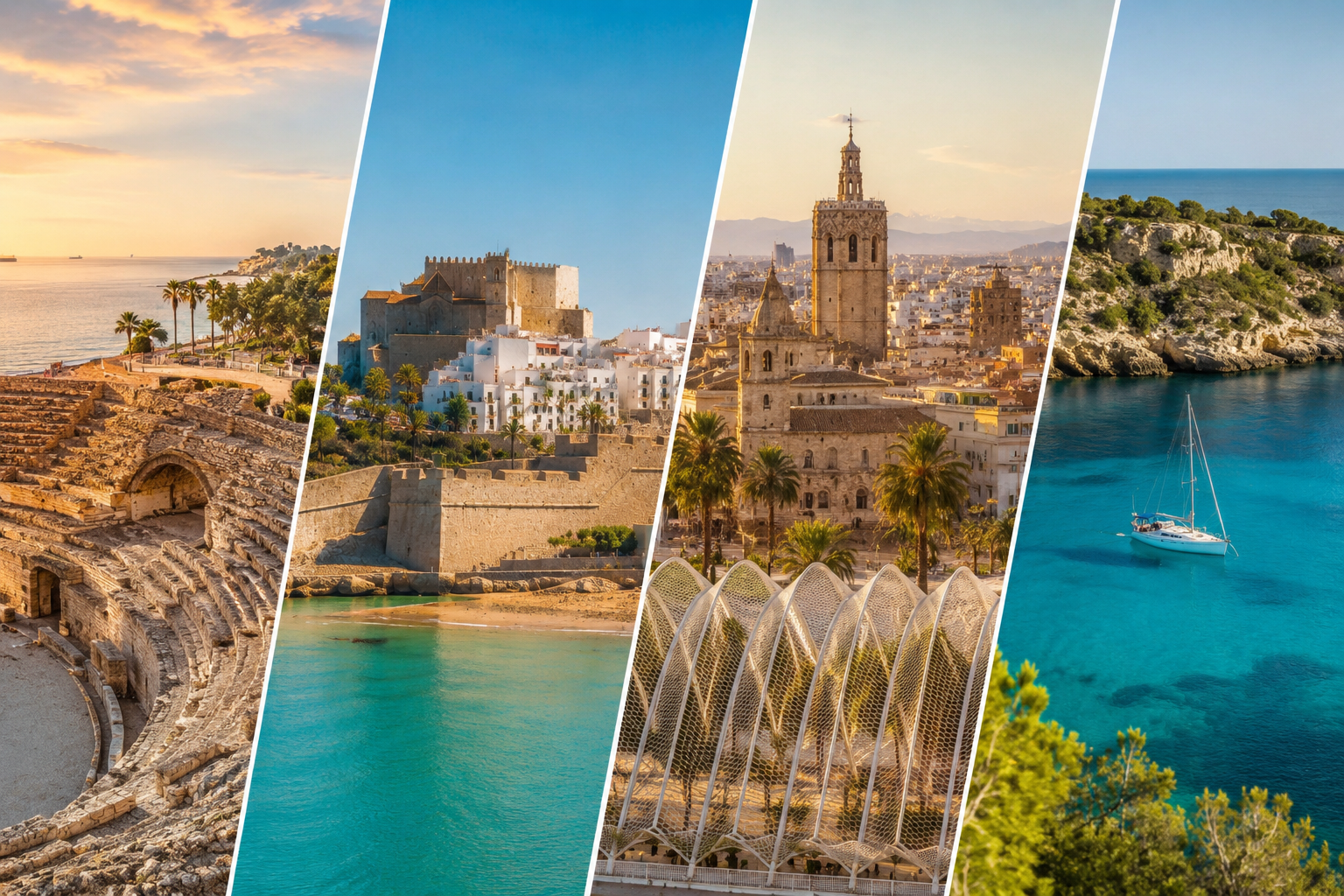
While many visitors rush toward larger cities, Tarragona quietly preserves one of the most impressive Roman legacies in the country. The city’s ancient amphitheatre, dramatically overlooking the Mediterranean Sea, remains one of the most beautiful historical sites on the Spanish coast.
But Tarragona’s charm goes far beyond its ruins.
Its old town is filled with narrow stone streets, hidden plazas and small vermouth bars where locals gather before lunch. Life here feels calmer, more relaxed and deeply Mediterranean.
Don’t miss:
- the Roman Amphitheatre,
- Tarragona Cathedral,
- the old Roman walls,
- and the famous Balcó del Mediterrani viewpoint.
If possible, spend the night. Tarragona becomes especially magical once the day visitors leave.
Travel tip:
High-speed trains connect Tarragona easily with both Madrid and Barcelona.
Stop 2 – Castellón & Peñíscola: Spain’s Quiet Mediterranean Coast
Continue south along the coast toward Castellón province, one of the least internationally explored parts of Mediterranean Spain.
This is a different kind of coastline: quieter, slower and far more local than many of Spain’s better-known beach destinations. Here, life revolves around seafood lunches, evening walks by the sea and long summers that seem to last forever.
The highlight of the area is undoubtedly Peñíscola.
Rising dramatically above the sea, this fortified medieval town feels almost cinematic. Its castle, narrow whitewashed streets and sea views make it one of the most beautiful small coastal towns in Spain.
Yet what makes this area special is not only its beauty, but its atmosphere. It still feels genuinely Spanish, without the overwhelming crowds found elsewhere along the Mediterranean.
And naturally, food plays a major role here. This stretch of coast is famous for its rice dishes, fresh seafood and Mediterranean produce.
Perfect for:
Travelers looking for hidden Mediterranean Spain beyond the usual tourist routes.
Stop 3 – Valencia: Creativity, Sun & Mediterranean Lifestyle
Valencia often becomes the biggest surprise of the trip.
Spain’s third-largest city somehow manages to feel vibrant and relaxed at the same time. It combines historic architecture, futuristic design, incredible food and beach life in a way few European cities can.
One moment you’re walking through centuries-old streets and local markets. The next, you’re standing among the futuristic buildings of the City of Arts and Sciences.
But Valencia’s true magic is its lifestyle.
People live outdoors here. Terraces are always busy, beaches are part of daily life and meals are never rushed. It’s the kind of city that invites you to slow down.
And of course, this is the birthplace of paella.
Locals take that very seriously and after trying an authentic Valencian paella, you’ll understand why.
Don’t miss:
- the Central Market,
- the Turia Gardens,
- the historic center,
- Malvarrosa Beach,
- and sunset by the marina.
Spend at least two full days here if you can.
Stop 4 — The Balearic Islands: Ending the Journey Slowly
To finish the route, take a short flight or ferry to the Balearic Islands.
For this itinerary, Mallorca and Menorca work especially well.
Mallorca offers dramatic mountain scenery, elegant villages, hidden coves and an increasingly sophisticated food scene. Menorca, meanwhile, feels quieter and more untouched, perfect for travelers seeking a slower rhythm.
What surprises many repeat visitors is that the Balearics are far more than beach destinations. Their culture, architecture and local traditions are deeply tied to Mediterranean history.
After several days moving through cities and coastal towns, the islands become the perfect final pause before heading home.
Why This Route Is Perfect for Second-Time Travelers
This itinerary is not about checking off Spain’s most famous landmarks.
It’s about discovering another side of the country:
- slower,
- more regional,
- more connected to local life,
- and deeply Mediterranean.
It combines Roman history, seaside towns, gastronomy, beaches, modern cities and island life — all within a single week.
Because sometimes the best way to truly experience Spain… is to come back for a second time.
Leave a Reply