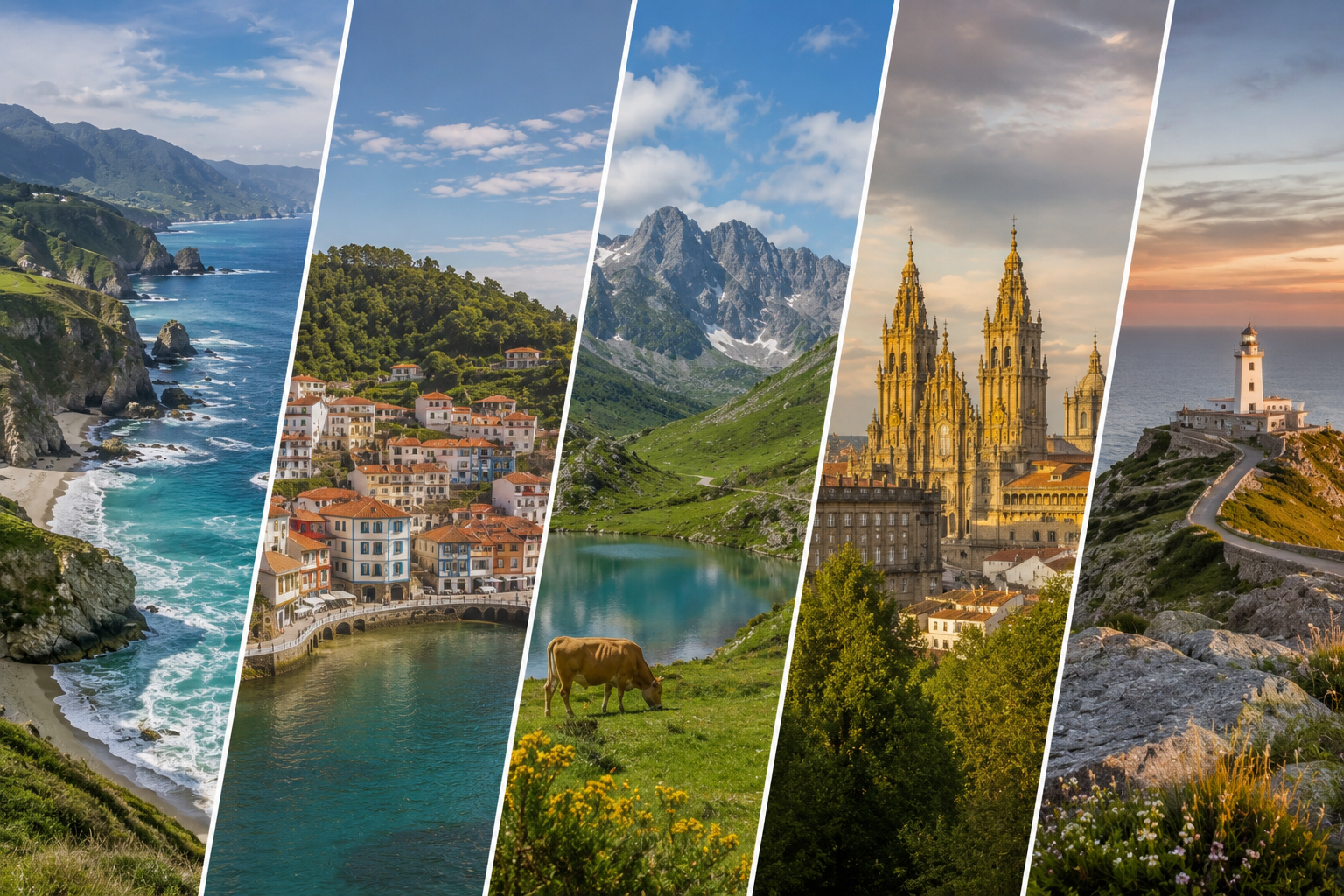
Most first-time visitors come to Spain expecting sunshine, flamenco and Mediterranean beaches. But northern Spain tells a completely different story.
Here, the landscape turns green and dramatic. Mountains plunge into the Cantabrian Sea, mist covers fishing villages in the mornings and some of the best food in the country is hidden inside tiny local taverns.
For travelers returning to Spain for a second time, the north offers one of the country’s most unforgettable experiences: a road trip through Cantabria, Asturias and Galicia, where nature, gastronomy and culture blend together at every turn.
This is not the Spain of crowded tourist landmarks.
This is wild Spain.
And the best way to discover it is slowly, ideally by car or motorbike.

While trains and buses connect some of the main cities along the Cantabrian coast, the true beauty of northern Spain lies in the freedom to stop at hidden beaches, mountain viewpoints and small fishing villages along the way.
When Is the Best Time to Do This Route?
The ideal months for this northern Spain itinerary are between May and early October.
- Late spring brings green landscapes, mild temperatures and fewer crowds.
- Summer offers longer days, lively coastal towns and the best weather for beaches and road trips.
- Early autumn may actually be the perfect balance: beautiful scenery, incredible food season and a calmer atmosphere.
Unlike southern Spain, temperatures here remain much milder during summer thanks to the Atlantic influence of the Cantabrian Sea.
However, weather in the north can be unpredictable at any time of year — and that’s part of its charm.
Stop 1 – Cantabria: Cliffs, Villages & Endless Green Landscapes
Cantabria is often overlooked by international travelers, yet it may be one of the most complete regions in northern Spain.
In a single day, you can move from dramatic Atlantic cliffs to medieval villages and then into the mountains of the Picos de Europa.
One of the essential stops is Santander, an elegant coastal city with beautiful beaches, seaside promenades and a relaxed atmosphere that feels very different from Spain’s larger urban centers.
But the true magic of Cantabria lies beyond the city.
Don’t miss:
- Santillana del Mar, one of Spain’s most beautiful medieval villages,
- Comillas and its modernist architecture,
- the wild beaches along the Cantabrian coast,
- and the breathtaking roads leading toward the Picos de Europa mountains.
Northern Spain is famous for its food, and Cantabria is no exception. Fresh seafood, anchovies, mountain stews and local cheeses all play an important role in the region’s identity.
Stop 2 – Asturias: Spain’s Wildest Coastline
Asturias feels almost cinematic. For me, Asturias has always felt especially personal. My mother is Asturian, and I’ve spent much of my life traveling through the region. It’s a place I deeply admire, love and continue to be fascinated by every time I return.
Green mountains, hidden beaches, dramatic cliffs and winding roads along the Cantabrian Sea create one of the most spectacular landscapes in the country.
For many travelers, Asturias becomes the highlight of the entire route.
The region is perfect for slow travel. Small fishing villages appear between cliffs, cows graze beside the ocean and nearly every road seems to lead to another incredible viewpoint.
Oviedo, Asturias’ elegant capital, offers charming streets, cider bars and a strong cultural identity. Meanwhile, coastal towns like Cudillero and Lastres look almost unreal, cascading down hillsides toward the sea.
Nature lovers should absolutely explore:
- the Lakes of Covadonga [yes, like my name :)]
- the Picos de Europa National Park,
- and the region’s dramatic coastal hiking trails.
And then there’s Asturian cider.
Unlike elsewhere in Spain, cider here is part of daily life and deeply connected to local culture. Watching it being traditionally poured from above the head is an experience in itself.
Travel tip:
Asturias is especially incredible by motorbike thanks to its winding mountain and coastal roads.
Stop 3 – Galicia: Atlantic Culture & Timeless Landscapes
Galicia feels different from the rest of Spain.
Its Celtic roots, Atlantic climate and powerful connection to the sea create a unique atmosphere that many travelers completely fall in love with.
This is a land of lighthouses, fishing ports, green hills and some of the best seafood in Europe.
Santiago de Compostela is naturally one of the region’s highlights. Beyond being the final destination of the Camino de Santiago, the city has an extraordinary atmosphere, especially at night when the historic center becomes quieter and more magical.
But Galicia’s beauty goes far beyond Santiago.
Some of the most unforgettable places include:
- the dramatic cliffs of Costa da Morte,
- the beaches of the Rías Baixas,
- the fishing town of Combarro,
- and the wild Atlantic scenery around Cape Finisterre.
Galicia is also one of Spain’s great gastronomic destinations. Octopus, shellfish, empanadas and Albariño wine are essential parts of the experience.
And perhaps more than anywhere else on this route, Galicia invites travelers to slow down completely.
Why Northern Spain Is Perfect for Second-Time Travelers
Northern Spain offers a completely different vision of the country.
Instead of dry landscapes and Mediterranean heat, you’ll find:
- green mountains,
- Atlantic cliffs,
- fishing villages,
- incredible gastronomy,
- and roads that seem designed for road trips.
It’s a route built for travelers who want to experience Spain beyond its most famous postcards.
A Spain shaped by the Cantabrian Sea and the Atlantic Ocean, quieter, wilder and deeply authentic.
Because sometimes the most surprising part of Spain… is the one many visitors never see the first time.
Leave a Reply